

Churning of the Milk Ocean
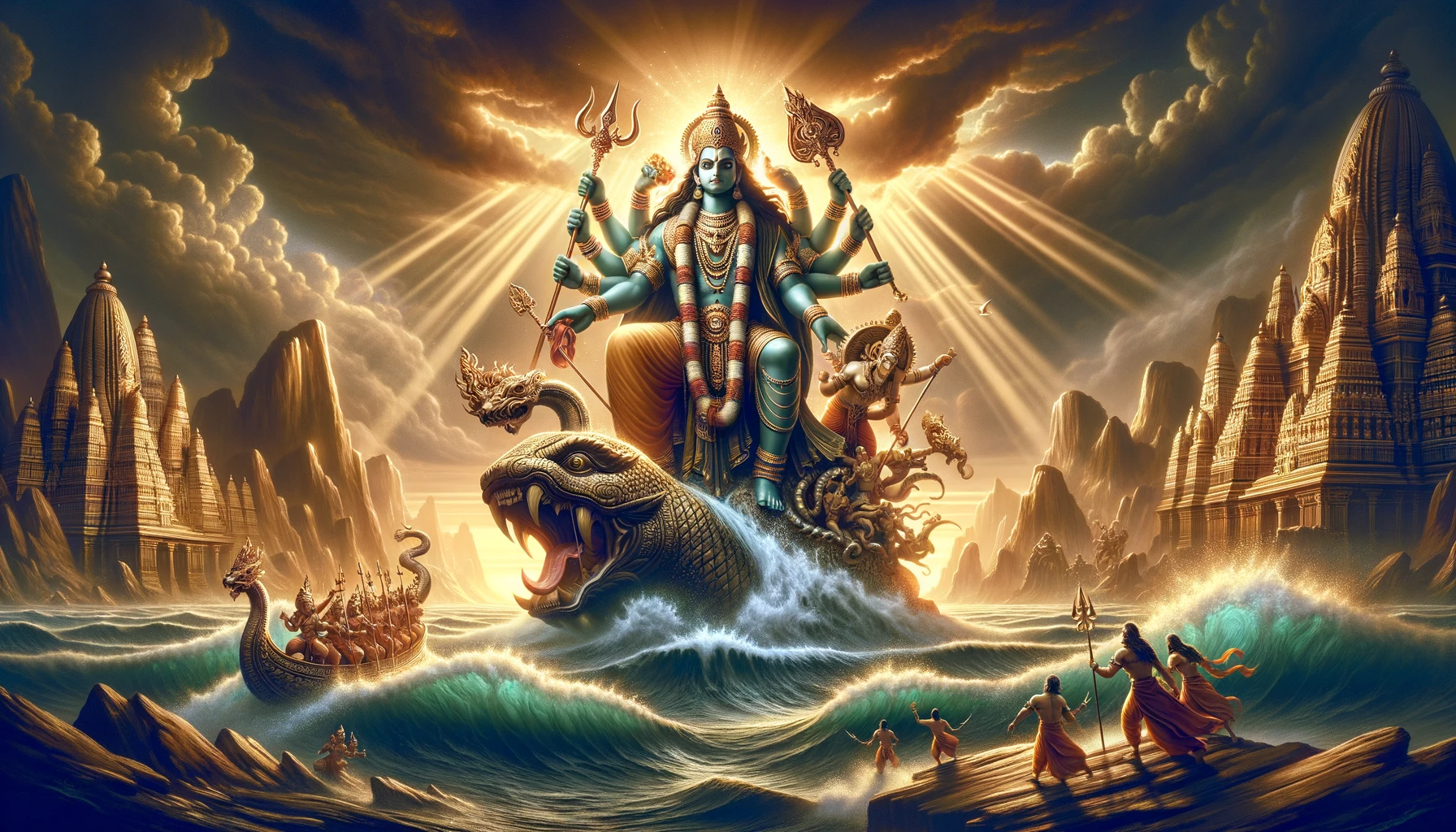
Churning of the Milk Ocean
In ancient times, the cosmos witnessed an extraordinary event known as the Churning of the Milk Ocean. This mythological tale from the Bhagavata Purana reveals a profound story where Devas and Asuras, despite their rivalry, joined forces in pursuit of Amrita, the nectar granting immortality. However, their journey was fraught with challenges, the most daunting being the sinking of Mount Mandara, their chosen churning rod. As despair loomed over their celestial quest, Lord Vishnu, embodying divine wisdom and protection, intervened in an unexpected form. This narrative not only illuminates the power of divine intervention but also imparts timeless lessons of perseverance and creative problem-solving that resonate even in our modern lives. Let us delve into this captivating story to explore its spiritual depth and modern relevance.
The Story
Introduction to the Cosmic Churning
The Churning of the Milk Ocean is a cornerstone of Hindu mythology, symbolizing the eternal struggle between good and evil. This cosmic event required the combined efforts of the Devas and Asuras, who momentarily set aside their differences for a greater cause. Their goal was the Amrita, a divine elixir that promised immortality, hidden within the depths of the cosmic ocean. The ocean itself represents the vast, uncharted potential of the universe, teeming with both treasures and challenges.
The churning process was no small feat. It demanded immense strength and cooperation, as the ocean was vast and its depths mysterious. The Devas and Asuras, representing opposing forces of light and darkness, understood that only through unity could they hope to succeed. This collaboration is a reminder that sometimes, adversaries must work together to achieve a common goal, reflecting the duality present in every aspect of existence.
The initial stage of the churning was marked by anticipation and the promise of untold rewards. However, as the narrative progresses, it becomes clear that the journey would not be straightforward. The cosmic ocean, a metaphor for life's trials, required more than brute force; it demanded strategy, innovation, and divine intervention. This set the stage for the unfolding drama where Lord Vishnu's wisdom would shine, guiding the participants towards their ultimate goal.
The Role of Mount Mandara
Mount Mandara, chosen as the churning rod, stood as a symbol of stability and strength. Its massive form was thought to be ideal for the task, representing the immovable force needed to stir the cosmic ocean. However, even the mightiest of mountains can falter when faced with the depths of the unknown. As the churning began, Mount Mandara started to sink, unable to withstand the immense pressure and turmoil of the ocean's depths.
This unexpected obstacle plunged the participants into despair. The sinking of Mount Mandara metaphorically highlights the challenges one faces when relying solely on tangible strength and stability. It serves as a reminder that even the most reliable structures can falter without the right support. The Devas and Asuras, despite their combined might, found themselves helpless, underscoring the limitations of physical power in the face of cosmic forces.
The sinking mountain became a turning point in the narrative, forcing the participants to seek help beyond their own capabilities. This scenario is reflective of moments in our lives where conventional solutions fail, and we must look beyond the obvious. In this crisis, the story introduces the need for divine intervention, setting the stage for Lord Vishnu's transformative role as Kurma, the giant tortoise, to provide the much-needed support.
Vishnu's Divine Intervention as Kurma
As Mount Mandara continued to sink, the situation seemed dire. It was at this critical juncture that Lord Vishnu, renowned for his calm wisdom and protective nature, incarnated as Kurma, the giant tortoise. This avatar was not a grand spectacle of power but a subtle and steadfast form, embodying the silent strength needed to uphold the mountain and sustain the churning process. Kurma's appearance signifies that divine intervention often comes in unexpected forms, quietly providing the foundation for great endeavors.
The Kurma Avatar underscores the importance of adaptability and resourcefulness. By transforming into a tortoise, Vishnu demonstrated the ability to provide support in a manner perfectly suited to the situation. This transformation highlights a key spiritual lesson: true strength lies in understanding and adapting to the needs of the moment, rather than imposing one's will upon it.
With Kurma's support, the churning resumed with renewed vigor. The presence of the tortoise not only stabilized Mount Mandara but also infused the participants with hope and determination. This divine intervention teaches us that in times of crisis, seeking help and being open to unconventional solutions can lead to triumph. It reminds us that persistence, combined with innovative support, can overcome even the most daunting challenges.
Outcome of the Churning
With the churning back on track, the cosmic ocean began to yield its treasures. These divine gifts included the celestial cow Kamadhenu, the wish-granting tree Kalpavriksha, and the goddess of wealth, Lakshmi. Each of these treasures symbolizes different aspects of abundance and prosperity, emphasizing the rewards of perseverance and unity in the face of adversity.
Among these treasures, the most coveted was the Amrita, the nectar of immortality. Its emergence marked the culmination of the arduous churning process, fulfilling the primary objective of the cosmic endeavor. The nectar represents the ultimate reward for those who endure trials and tribulations with patience and faith. It serves as a metaphor for spiritual enlightenment and eternal life, attainable through dedication and divine grace.
The outcome of the churning also reflects the balance of cosmic forces. While the Devas gained the nectar, the Asuras were momentarily distracted, showcasing the interplay of destiny and divine will. This balance is crucial in maintaining the order of the universe, reminding us that every action has consequences and that divine intervention ensures harmony in the grand scheme of things.
Lessons from the Kurma Avatar
The tale of the Churning of the Milk Ocean and the Kurma Avatar offers profound lessons that extend beyond mythology. One of the core teachings is the power of persistence and the value of seeking help when needed. Just as the Devas and Asuras united despite their differences, we too must embrace collaboration in our endeavors, especially when facing challenges that seem insurmountable.
Kurma's role as a steadfast supporter emphasizes the importance of being adaptable and resourceful. In modern life, this translates to being open to new ideas and solutions, and recognizing that support may come from unexpected sources. The story encourages us to remain steady and patient, trusting that perseverance, combined with innovative approaches, will lead to success.
Finally, the narrative highlights the significance of divine grace and intervention in achieving our goals. It reminds us that while we must strive with all our might, the ultimate outcome often lies beyond our control, guided by a higher power. This awareness fosters humility and faith, encouraging us to align our actions with divine will and embrace the unexpected turns that lead us towards triumph.
Bhagavad Gita Verse
BG 9.22अनन्याश्चिन्तयन्तो मां ये जनाः पर्युपासते। तेषां नित्याभियुक्तानां योगक्षेमं वहाम्यहम्
“For those men who worship Me alone, thinking of no one else, for those ever-united, I secure what they have not already possessed and preserve what they already possess.”
This story is part of our curated collection designed to help readers navigate emotional and life challenges through meaningful storytelling rooted in the timeless wisdom of Lord Jagannath.