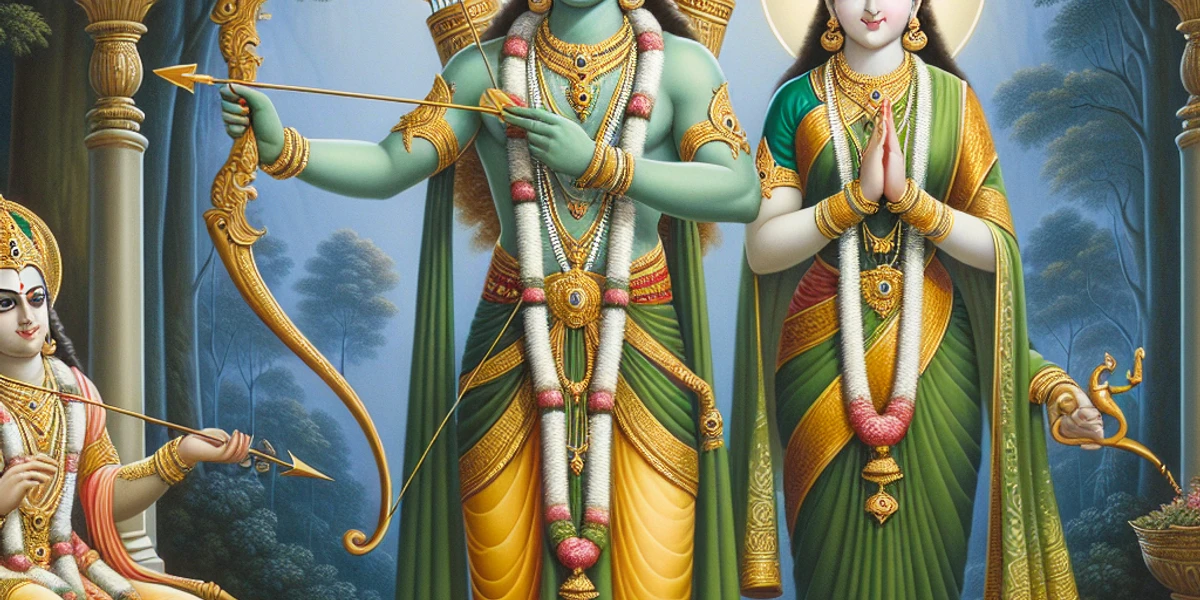
In a time of valor and divine destinies, the kingdom of Mithila awaited a moment that would change the course of history. King Janaka, a ruler known for his wisdom and strength, had declared a grand swayamvara for his beloved daughter, Sita. The challenge was set: suitors must lift and string the mighty bow of Lord Shiva, a task that seemed insurmountable. As the sun rose over the vibrant court, the air buzzed with anticipation. Would any warrior possess the strength to wield the bow? Among the gathered princes stood Rama, the prince of Ayodhya, whose heart was set on winning Sita's hand. Little did they know, this moment would reveal the true nature of divine strength and destiny, as Rama prepared to face the challenge that lay before him.
The Story
In a time of valor and divine destinies, the kingdom of Mithila awaited a moment that would change the course of history. King Janaka, a ruler known for his wisdom and strength, had declared a grand swayamvara for his beloved daughter, Sita. The challenge was set: suitors must lift and string the mighty bow of Lord Shiva, a task that seemed insurmountable. As the sun rose over the vibrant court, the air buzzed with anticipation. Would any warrior possess the strength to wield the bow? Among the gathered princes stood Rama, the prince of Ayodhya, whose heart was set on winning Sita's hand. Little did they know, this moment would reveal the true nature of divine strength and destiny, as Rama prepared to face the challenge that lay before him.
The court of King Janaka was adorned with vibrant flowers and shimmering decorations, echoing the excitement of the assembled crowd. As suitors attempted to lift the bow, their faces contorted with strain and frustration, the atmosphere thickened with tension. One by one, they failed, their hopes dashed against the might of the divine weapon. Then, Rama stepped forward, his demeanor calm and composed. With a graceful stride, he approached the colossal bow, its intricate carvings gleaming under the sunlight. As he grasped the bow, a hush fell over the crowd. The very air seemed to vibrate with anticipation. With a swift motion, Rama lifted the bow effortlessly, showcasing not just physical strength but a connection to the divine. The bow creaked ominously, and in a moment that felt suspended in time, he drew it back and released it with a thunderous crack. The bow shattered into pieces, sending shards flying across the court, and gasps erupted from the onlookers. In that instant, Rama's strength was revealed, not just as a warrior but as an embodiment of dharma, destined to unite with Sita.
The atmosphere was electric, filled with the scent of blooming flowers and the sound of rustling silk. The vibrant colors of the court contrasted with the somber faces of the defeated suitors. The sun cast a golden hue over the scene, illuminating Rama as he stood poised before the bow, embodying both grace and strength. The crowd held its breath, the silence punctuated only by the distant chirping of birds, as all eyes focused on the unfolding drama.
As the bow shattered, a wave of emotions washed over Rama. He felt a surge of triumph but also the weight of expectation that now rested on his shoulders. Sita, watching from her throne, felt her heart race, torn between admiration for Rama's strength and the gravity of her own fate. Would she be judged solely by her father's decree, or was there more to her destiny than this contest? King Janaka, though proud of the spectacle, felt a flicker of concern. Would this union bring peace or turmoil? The court erupted in cheers, but within Rama, a quiet storm brewed. He understood that this victory was not merely about winning Sita's hand; it was a testament to his dharma and the responsibilities that came with it. The challenge had been met, but the path ahead was fraught with uncertainties. Would he be able to uphold the ideals of honor and righteousness in the face of the trials that awaited him?
Rama's heart was a battleground of conflicting emotions. The joy of victory was overshadowed by the realization of the responsibilities that lay ahead. He questioned whether he was truly worthy of Sita, a princess of such grace and virtue. The expectations of his family and the kingdom weighed heavily on him. Would he be able to protect her and fulfill his dharma as a ruler? The cheers of the crowd felt distant, as he grappled with the enormity of his actions and their implications for the future.
In the midst of the celebration, a divine presence enveloped the court, illuminating the space with a celestial glow. The atmosphere shifted as the essence of Lord Shiva seemed to descend upon the gathering. The crowd fell silent, sensing the divine energy that had manifested. Rama, feeling a deep connection to the divine, understood that his strength was not solely his own but a gift from the gods. In that moment, he offered a silent prayer of gratitude, acknowledging the role of divine will in his triumph. The bow, a symbol of Shiva's power, had not just been a test of strength but a bridge to the divine. The presence of Lord Shiva reminded all present that true strength lies in humility and devotion.
As the divine light enveloped Rama, he felt a profound sense of peace and clarity. The whispers of the crowd faded, replaced by a deep connection to the cosmic order. In that moment, he understood that his actions were part of a greater plan, a tapestry woven by the hands of the divine. The bow, once a mere weapon, transformed into a symbol of unity between the mortal and the divine, reinforcing the idea that true strength comes from surrendering to a higher purpose.
As the dust settled from the shattered bow, the implications of Rama's victory began to unfold. King Janaka, filled with pride and joy, welcomed Rama as his future son-in-law. The court erupted into celebrations, but beneath the surface, the political landscape shifted. Allies and rivals alike began to take notice of Rama's strength, and whispers of his destiny spread through the kingdom. Sita, now engaged to Rama, felt a mixture of joy and apprehension. She understood that her life was intertwined with his, and the challenges they would face together were yet to come. The union of Rama and Sita was not just a personal affair; it was a significant moment that would shape the future of their kingdoms and the very fabric of dharma itself.
The political ramifications of Rama's victory were profound. King Janaka's alliance with Rama's family strengthened the bonds between their kingdoms, promoting peace and cooperation. However, the challenges ahead loomed large. With the union came the responsibility of upholding dharma and navigating the complexities of royal life. Sita's acceptance of Rama as her husband marked the beginning of a journey that would test their love and commitment, setting the stage for the trials that awaited them.
In the moments following the announcement of their engagement, Rama and Sita exchanged glances filled with unspoken understanding. Both knew that their lives were forever altered, bound by fate and duty. As they stood before the court, the weight of their responsibilities loomed large. Rama felt a surge of determination, vowing to protect Sita and uphold the ideals of righteousness. Sita, in turn, embraced her role as a partner, ready to face the challenges ahead. The union was not merely a personal victory; it was a sacred commitment to uphold dharma, love, and honor. In that moment, they understood that their journey together was just beginning, and the trials they would face would only strengthen their bond.
Rama's realization of his responsibilities transformed him from a mere prince into a guardian of dharma. He understood that true strength lies not just in physical prowess but in the ability to protect and nurture those we love. Sita's acceptance of her role as a partner in this journey marked the beginning of a profound alliance, one that would echo through the ages as a testament to love, duty, and the pursuit of righteousness.
The story of Rama breaking Shiva's bow and winning Sita's hand resonates through the ages, reminding us of the importance of strength, duty, and divine will. In a world filled with challenges, this tale serves as a beacon of hope and inspiration. The union of Rama and Sita is a testament to the power of love and the commitment to uphold dharma, even in the face of adversity. As we reflect on their journey, we are reminded that our own lives are intertwined with the greater cosmic order, and that true strength comes from aligning ourselves with our higher purpose.
This story holds relevance today as we navigate our own challenges and responsibilities. It teaches us that true strength is not just about physical power, but about the courage to uphold our values and protect those we love. The legacy of Rama and Sita inspires us to pursue our own paths with integrity, reminding us that every action we take can contribute to the greater good, echoing the timeless principles of dharma.
Moral of the Story
Rama's ability to lift and string Lord Shiva's bow during Sita's swayamvara illustrates the profound connection between divine grace and individual strength. Unlike the other suitors who failed through sheer physical effort, Rama's success stemmed from his calm demeanor and inner spiritual strength, highlighting that divine favor is essential for achieving seemingly impossible tasks.
Why This Story Matters
This specific story underscores the importance of inner strength and divine connection in facing challenges, a lesson that resonates in today's world filled with overwhelming pressures and expectations. Just as Rama demonstrated composure and divine alignment, individuals today can benefit from cultivating inner peace and connecting with their own purpose amidst external chaos.
This story is part of our curated collection designed to help readers navigate emotional and life challenges through meaningful storytelling rooted in the timeless wisdom of Lord Jagannath.