
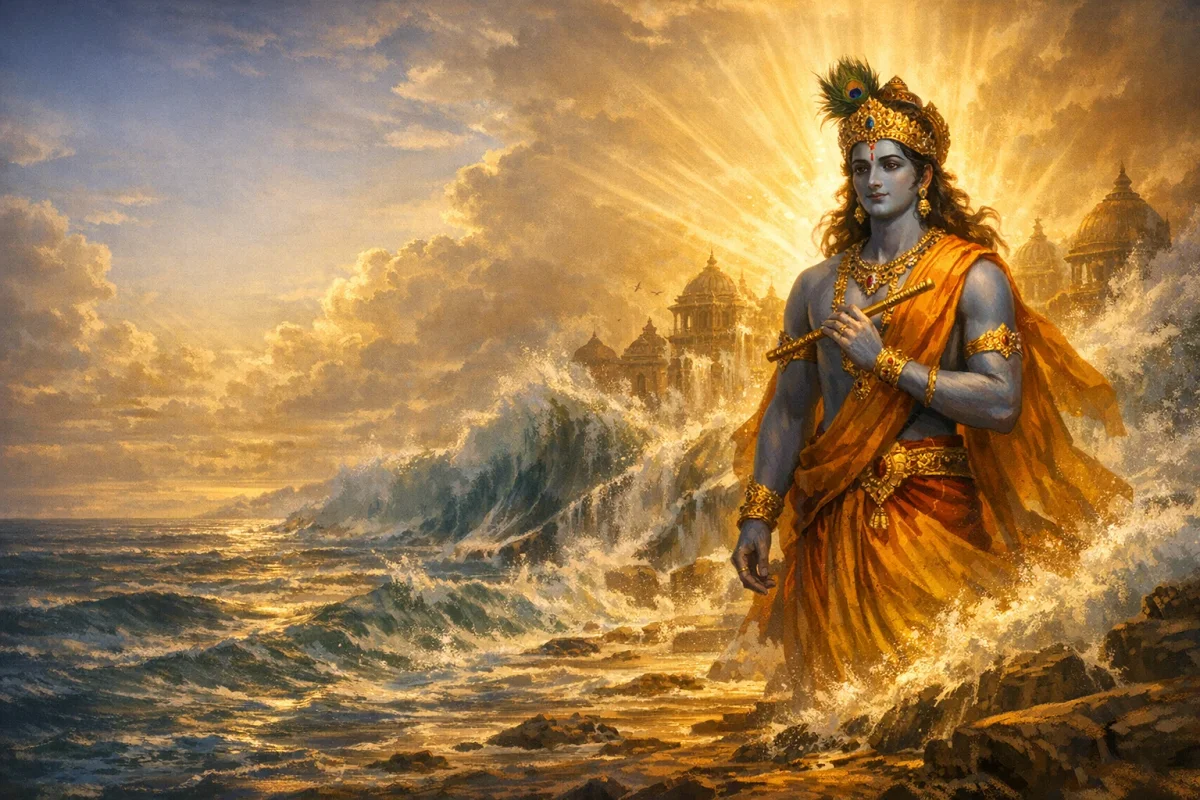
The sun began its descent on the horizon, casting a golden glow over the majestic city of Dwaraka. The air was thick with an unspoken tension, a prelude to the divine drama about to unfold. In the heart of this sacred city, the Yadava clan, once united by blood and purpose, was on the brink of a catastrophic collapse. This was not just a tale of the end of a dynasty, but the withdrawal of Krishna, the Supreme Being, from His earthly abode, as narrated in the Srimad Bhagavatam.
The Story
The sun began its descent on the horizon, casting a golden glow over the majestic city of Dwaraka. The air was thick with an unspoken tension, a prelude to the divine drama about to unfold. In the heart of this sacred city, the Yadava clan, once united by blood and purpose, was on the brink of a catastrophic collapse. This was not just a tale of the end of a dynasty, but the withdrawal of Krishna, the Supreme Being, from His earthly abode, as narrated in the Srimad Bhagavatam.
The ocean breeze carried whispers of destiny as the Yadavas gathered for a festival that would soon spiral into chaos. Laughter turned to anger, and camaraderie was replaced by animosity. In a tragic twist of fate, fueled by pride and intoxication, the mighty Yadavas turned against each other. The once harmonious sound of celebration was now a cacophony of clashing weapons and cries, as brother fought brother till the sands were stained with the blood of their own.
The sky darkened ominously, and the ground trembled with the weight of destiny. The air was filled with the metallic scent of conflict, and the distant roar of the ocean served as a haunting backdrop to the carnage.
Amidst the chaos, Krishna stood apart, His serene visage a stark contrast to the turmoil. The Lord, who had guided the Yadavas with wisdom and love, now observed the fulfillment of karma. Despite His divine awareness, the human aspect of His form felt the sorrow of witnessing the self-destruction of His beloved clan.
Within Him, there was a deep, poignant sadness—a reflection of the inevitable cycle of creation and destruction. The conflict was not just external; it raged within Krishna's heart, where divine knowledge and human emotion intertwined.
In the quiet aftermath of destruction, Krishna retreated to the forest, aware that His earthly mission was complete. As He sat beneath a tree, a hunter, mistaking Him for a deer, accidentally shot an arrow that would enable Krishna to withdraw His divine form.
In this moment, Krishna revealed His transcendental nature, assuring the hunter of his innocence and promising liberation. The divine light that emanated from Him illuminated the forest, a final testament to His eternal presence.
With Krishna's departure, the protective aura around Dwaraka dissolved. Soon, the ocean, which had long revered the city, rose with a gentle yet unstoppable force, reclaiming the land. The magnificent city, once a beacon of divine architecture and culture, was submerged beneath the waves.
The spiritual vacuum left by Krishna's departure marked the beginning of Kali Yuga, a time of moral decline. Yet, His teachings and legacy continued to guide those who sought the path of righteousness.
As the waters settled over Dwaraka, the cosmic order found its balance once more. The earth, now devoid of the direct presence of Krishna, bore the memory of His divine play.
In the hearts of His devotees, the realization dawned that while Krishna had left the earthly plane, His essence remained eternally accessible through devotion and the teachings of the Srimad Bhagavatam.
Though the world has moved into Kali Yuga, the wisdom of Krishna remains a guiding light. His life teaches us about the impermanence of worldly power and the eternal nature of divine love.
True strength lies in humility and devotion. Even amidst chaos, divine grace prevails. The end is but a new beginning in the eternal cycle of life.
Bhagavad Gita Verse
2.14मात्रास्पर्शास्तु कौन्तेय शीतोष्णसुखदुःखदाः। आगमापायिनोऽनित्यास्तांस्तितिक्षस्व भारत
“The contact of the senses with the objects, O son of Kunti, which causes heat and cold, pleasure and pain, has a beginning and an end; they are impermanent; endure them bravely, O Arjuna.”
Moral of the Story
The story of Krishna's departure and the end of Dwaraka teaches us about the impermanence of life and the importance of cherishing our relationships and experiences. It reminds us that all material achievements are transient, and we must focus on spiritual growth and connection with the divine.
How to Apply This Story in Real Life
Practice gratitude for the relationships and experiences in your life.
Engage in regular self-reflection to assess your priorities and values.
Cultivate a spiritual practice that helps you connect with the divine and find inner strength.
Why This Story Matters
This story holds profound relevance in today's fast-paced world, where people often get caught up in material pursuits. It serves as a reminder to prioritize spiritual values and authentic connections over temporary gains. As we face challenges and changes in our lives, understanding the transient nature of existence can help us cultivate resilience and inner peace.
Frequently Asked Questions (FAQs)
Krishna's departure symbolizes the end of an era and teaches us about the inevitable changes in life.
It highlights the importance of focusing on spiritual growth and relationships amidst material distractions.
We learn about the impermanence of material success and the need to seek lasting fulfillment through spirituality.

Suggested Books & Puja Items




This story is part of our curated collection designed to help readers navigate emotional and life challenges through meaningful storytelling rooted in the timeless wisdom of Lord Jagannath.