
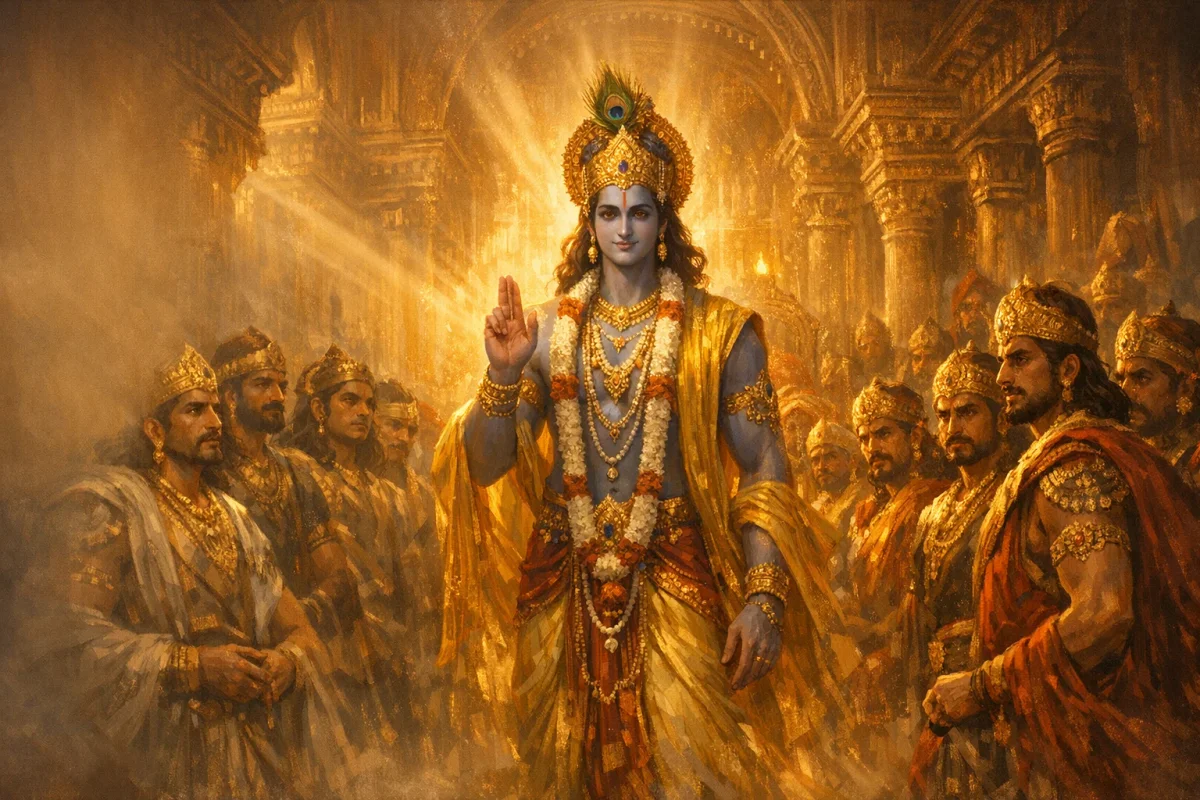
Amidst the echoes of destiny, a divine charioteer arrived at the gates of Hastinapura, his presence like a beacon of hope against the gathering storm of war. The air was thick with anticipation, as if the very cosmos held its breath, waiting for the outcome of this celestial envoy's mission. Krishna, the eternal diplomat, stood poised to bridge the chasm between warring cousins, the Pandavas and the Kauravas, in a last attempt to avert the impending carnage of Kurukshetra.
The Story
Amidst the echoes of destiny, a divine charioteer arrived at the gates of Hastinapura, his presence like a beacon of hope against the gathering storm of war. The air was thick with anticipation, as if the very cosmos held its breath, waiting for the outcome of this celestial envoy's mission. Krishna, the eternal diplomat, stood poised to bridge the chasm between warring cousins, the Pandavas and the Kauravas, in a last attempt to avert the impending carnage of Kurukshetra.
The era was Dvapara Yuga, a time when the kingdom of Hastinapura stood as the epicenter of power and intrigue. Amidst the tension-filled halls of the Kuru dynasty, Krishna, the divine diplomat, entered as a harbinger of peace. The Pandavas, rightful heirs to the throne, had been exiled, their dignity trampled by the machinations of their cousins, the Kauravas. Yet, Krishna's eyes held a vision beyond personal vendettas—he sought harmony, knowing that a war would unsettle the cosmic balance itself.
The grand court of Hastinapura buzzed with whispers, its opulent pillars reflecting the flickering torchlight, as Krishna's serene visage contrasted sharply against the undercurrent of tension.
Krishna's voice resonated through the chamber, a melodious plea for reconciliation. He proposed a fair division of the kingdom, urging Duryodhana to embrace peace over pride. However, blinded by ambition and arrogance, the Kauravas rejected his proposal, their hearts hardened like stone. The tension in the room was palpable, the silence almost deafening as Krishna's words hung in the air, a mournful prophecy ignored.
Krishna, though divine, felt the weight of human stubbornness. In his heart, there was a flicker of sadness for the inevitable path chosen by those who failed to see beyond their own desires.
As the court watched, Krishna revealed his divine form, a cosmic spectacle that left the assembly awestruck. His radiant visage encompassed the universe, the heavens and earth bound within his being. Yet, even this divine intervention failed to sway Duryodhana's resolve, as the prince turned away from the light of truth.
Krishna's Vishwarupa, a transcendental vision displaying the infinite cosmos within his form, symbolized the omnipresent power that transcends human folly.
The rejection of peace cast a shadow over Hastinapura, setting the stage for the impending war of Kurukshetra. The Pandavas, though reluctant, prepared to reclaim justice through arms. The spiritual and political ramifications were immense, with the entire Bharatavarsha poised on the brink of cataclysm.
Krishna's mission, though unsuccessful in averting war, laid bare the moral choices of the characters, establishing the dharmic framework within which the epic battle would unfold.
In the aftermath of Krishna's departure, the realization dawned on the Pandavas and their allies—they were custodians of dharma. This understanding transformed their resolve, reinforcing their commitment to fight not just for a throne, but for righteousness itself.
The Pandavas recognized their role in restoring cosmic order, with Krishna's guidance as their moral compass.
The lessons of Krishna’s peace mission echo through time, urging humanity to choose dialogue over discord. In a world often divided by conflict, the story reminds us that true leadership lies in striving for unity and justice. Even when faced with rejection, the pursuit of peace remains a noble endeavor.
Peace is the true victory; even when it seems elusive, the effort to achieve it is never in vain.
Bhagavad Gita Verse
2.48योगस्थः कुरु कर्माणि सङ्गं त्यक्त्वा धनञ्जय। सिद्ध्यसिद्ध्योः समो भूत्वा समत्वं योग उच्यते
“Perform action, O Arjuna, being steadfast in Yoga, abandoning attachment and balanced in success and failure; evenness of mind is called Yoga.”
Moral of the Story
The story of Krishna's Peace Mission to Hastinapura teaches us the importance of diplomacy, patience, and understanding in resolving conflicts. It highlights that dialogue and compassion can pave the way for harmony and peace, even in the most turbulent situations. True leadership lies in the willingness to listen and seek a common ground.
How to Apply This Story in Real Life
Engage in open conversations to resolve misunderstandings in personal and professional relationships.
Practice active listening and empathy in discussions to foster a culture of peace.
Seek common ground and collaborative solutions in community conflicts to promote unity.
Why This Story Matters
This story is particularly relevant today as the world faces numerous conflicts and divisions, whether in politics, communities, or personal relationships. It underscores the need for peaceful dialogue and the power of negotiation over violence. In a time when disagreements often escalate into hostility, Krishna's approach serves as a timeless reminder of the importance of compassion and understanding in finding resolutions.
Frequently Asked Questions (FAQs)
The central theme was the importance of diplomacy and understanding in resolving conflicts.
We can apply these lessons by engaging in peaceful dialogues and seeking to understand others' perspectives in conflicts.
Krishna is considered a symbol of peace because he consistently sought resolution and harmony, prioritizing diplomacy over warfare.

Suggested Books & Puja Items




This story is part of our curated collection designed to help readers navigate emotional and life challenges through meaningful storytelling rooted in the timeless wisdom of Lord Jagannath.