
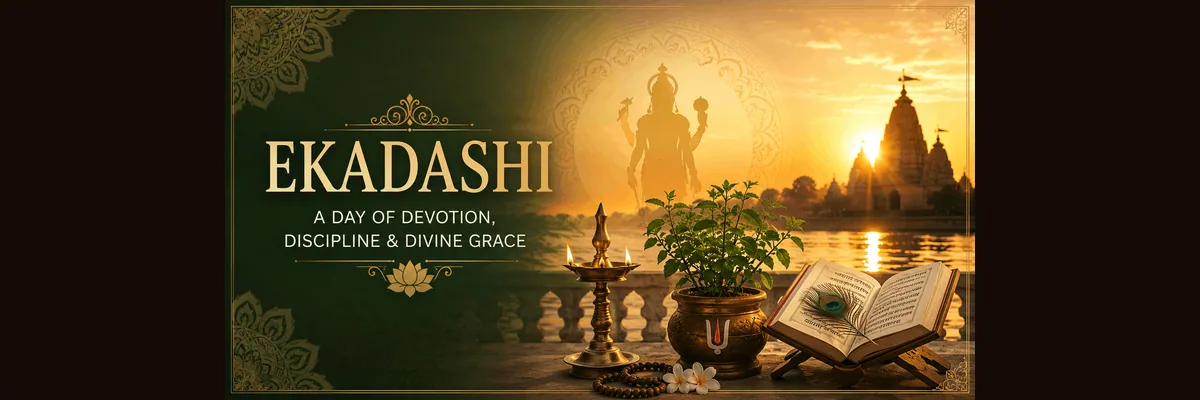
Also known as: Shayani Ekadashi, Hari Shayani Ekadashi, Padma Ekadashi
Devshayani Ekadashi is observed in the Shukla Paksha of the Ashadha month and is dedicated to Lord Vishnu. Marks the beginning of Chaturmas (four-month period) when Lord Vishnu goes to cosmic sleep; most auspicious Ekadashi The Vrat Katha below is drawn from the traditional scriptural narrative.
Spiritual Significance
Marks the beginning of Chaturmas (four-month period) when Lord Vishnu goes to cosmic sleep; most auspicious Ekadashi
The story of the famine in the kingdom of King Mandhata
Arjuna asked, "O Lord Krishna! What is the significance of the Ekadashi that occurs during the Shukla Paksha in the month of Ashadha? Which deity is worshipped on this day? What is the procedure for observing this fast? Please explain all of this in detail."
Lord Krishna said, "O Arjuna! Once, Devarshi Narada asked Lord Brahma the same question. Lord Brahma replied Narada that you have posed the best question for the salvation of all beings in Kaliyuga. The Ekadashi fast is the most excellent of all fasts. By observing this fast, all sins are erased. This Ekadashi is known as Devshayani Ekadashi. When this fast is observed, Lord Vishnu is pleased. In this context, I am sharing an ancient story; listen carefully - There was a Suryavanshi king, belonging to the Ikshvaku dynasty, named Mandhata. He was a truthful man, a great ascetic, and an emperor. He ruled his kingdom with compassion, treating his subjects like his own children. Under his reign, the kingdom flourished and his subjects lived happily. No famine had ever struck his land, and it was shielded from natural disasters as well. However, by an unforeseen turn of fate, one day a terrible famine swept through his kingdom, leaving the people extremely unhappy due to the lack of food. No Yajnas were performed in the kingdom. Afflicted by famine, one day the people approached the king with sorrow in their hearts and pleaded - "O King! The foundation of all creation is rain. Due to the lack of rain, we are experiencing a famine in the kingdom and people are dying of starvation. O Lord of the earth, please do something to alleviate our suffering. If we do not receive relief from this famine soon, we will have no choice but to seek refuge in another kingdom."
The king listened to his people and said - "You are right. Many of you are unhappy because of the lack of rain. Although I am reflecting deeply on this matter, I cannot identify any faults in my actions. I am making significant efforts to alleviate your suffering, so please do not worry. I promise to find a solution."
After listening to the king's words, the people went away. King Mandhata worshipped God and then set off for the forest with a small group of selected individuals. While wandering through the hermitages of various sages and ascetics, he finally arrived at the hermitage of Rishi Angira, the mind-born son of Brahma Ji. After dismounting from his chariot, the king entered the hermitage. The Rishi had just completed his daily rituals when the king arrived before him and paid his respects. The Rishi blessed the king and then inquired - "O King! Please tell me the purpose of your visit".
The king said - "O great sage! There has been no rain in my kingdom for the past three years. Because of this, there is a famine, and the people are suffering. I rule according to Dharma, yet I do not understand how this famine has occurred. Now, I have come before you to resolve this doubt. Please have mercy and tell me how I can solve this problem and alleviate the suffering of my people."
After listening to the entire account, the Rishi said - "O King! The path to liberation from all afflictions lies in sincere devotion to Lord Vishnu. If you wish to be freed from this suffering, then observe the Devshayani Ekadashi fast, which occurs in the Shukla Paksha during the month of Ashadha, following the proper rituals. By the power of this fast, rain will return to your kingdom, and the people will regain their happiness, as this Ekadashi fast brings success and alleviates all suffering."
On hearing the words of the Rishi, the king returned to his city and observed the Devshayani Ekadashi fast with the appropriate rituals. As a result of this fast, there was abundant rainfall in the kingdom, freeing the people from famine.
This Ekadashi is also known as Padma Ekadashi. By observing this fast, Lord Vishnu is pleased, therefore those who desire Moksha (liberation) should observe this Ekadashi fast. The Chaturmasya Vrat is also started from this Ekadashi fast."
Key Teachings
- To find relief from one's suffering, one should not harm others. By relying on one's own strength, maintaining complete faith and devotion to God and performing good deeds as advised by saints, even the greatest afflictions can be overcome with ease.
- Even during divine rest, protection continues; observing sacred periods brings immense merit
- Observe this Ekadashi to begin Chaturmas vows and gain maximum spiritual merit
Benefits of Observing the Vrat
- Begins Chaturmas; grants merit of all pilgrimages and Ekadashis
- Marks the beginning of Chaturmas (four-month period) when Lord Vishnu goes to cosmic sleep; most auspicious Ekadashi
- Purification from accumulated sins and negative karma.
- Cultivation of self-discipline, devotion, and remembrance of Lord Vishnu.
- Spiritual merit equivalent to many pilgrimages and charitable acts, leading toward liberation (moksha).
Conclusion
Observing Devshayani Ekadashi with sincere devotion, fasting, and remembrance of Lord Vishnu purifies the heart and bestows spiritual merit. Devotees who read or listen to this Vrat Katha with faith share in its blessings.
Frequently Asked Questions (FAQs)
The story of the famine in the kingdom of King Mandhata. Arjuna asked, "O Lord Krishna! What is the significance of the Ekadashi that occurs during the Shukla Paksha in the month of Ashadha? Which deity is worshipped on this day? What is the procedure for observing this fast? …
Marks the beginning of Chaturmas (four-month period) when Lord Vishnu goes to cosmic sleep; most auspicious Ekadashi
Begins Chaturmas; grants merit of all pilgrimages and Ekadashis Marks the beginning of Chaturmas (four-month period) when Lord Vishnu goes to cosmic sleep; most auspicious Ekadashi Purification from accumulated sins and negative karma.
Source: Master Ekadashi Vrat Katha Repository. This Vrat Katha is a timeless scriptural narrative, reused across all years and not generated by AI.